Teotihuacán sits about an hour north of Mexico City as a vast archaeological zone built by an unknown civilization starting around 100 CE. The two main pyramids, the Pyramid of the Sun (66 meters tall) and the smaller Pyramid of the Moon, anchor a 2.5-kilometer ceremonial avenue called the Avenue of the Dead lined with temples and plazas. The site reached its peak around 500 CE with a population of 125,000–200,000 before a catastrophic fire in the 700s emptied it. Plan 4–5 hours minimum; the entrance fee is 210 pesos for foreign tourists, hours are 8 am to 5 pm daily, and the easiest route is the bus from Autobuses del Norte metro station.
Teotihuacán is the pyramids everyone pictures when they think of Mexico: two massive structures rising from a flat valley, surrounded by the remains of a city that was old when Rome fell. No one knows who built it or what destroyed it, and that mystery is half the reason to go.
The city nobody remembers
The civilization that built Teotihuacán arrived in central Mexico sometime before 400 BCE, but the major construction started around 100 CE with the Pyramid of the Sun. By 500 CE, the city had grown to somewhere between 125,000 and 200,000 people, making it one of the largest cities in the world at the time. It was a planned metropolis laid out on a grid, with a working government, a military, and a trade network that sent obsidian and other goods across Mexico and Mesoamerica.
Then, in the 700s, something happened: a massive fire burned through the ceremonial center, and the city was abandoned. Archaeologists don’t know why: whether it was an accident, an uprising, a collapse of government, or something else. By the time the Aztecs encountered the ruins centuries later, the city was already a thousand years old, and no one knew who built it. They named it Teotihuacán, which means “the place where the gods were created” in Nahuatl, but that was mythology filling in for history.
What to see
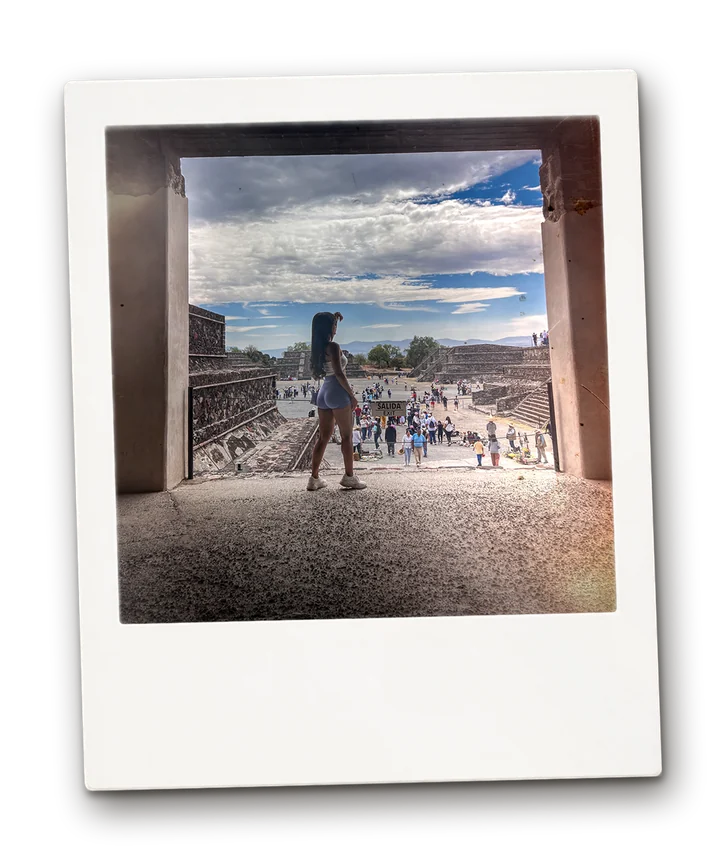
The site is large, laid out along a north-south axis called the Avenue of the Dead, which stretches about 2.5 kilometers with temples, palaces, and smaller pyramids on both sides.
The Pyramid of the Sun is the dominant structure: 66 meters tall, built in five tiers, with a temple once standing at its summit. You can no longer climb it (the stairs were closed to protect the structure), but you can walk around it and get a sense of its scale. Many visitors come just for this one.
The Pyramid of the Moon sits at the north end of the avenue, smaller than the Sun but surrounded by a plaza with better sightlines. Its name is a mistranslation; it’s correctly called the Pyramid of Rain, but the Moon name stuck. You can climb about halfway up it, which gives a vantage point over the site and a better feel for how the pyramids sit in relation to the rest of the city. Note: Tour guides are no longer permitted to give speeches at the top due to security changes following an incident in April 2026.
The Avenue of the Dead itself is the walk: nearly a mile and a half of ancient stone, lined with the foundations of what used to be temples and administrative buildings, with well-preserved murals still visible on some structures.
The Temple of the Feathered Serpent (also called the Temple of Quetzalcoatl) sits south of the main avenue and is the most ornately decorated structure on the site, carved with serpent heads and feathers. You can climb to the Adosada platform to get a closer look.
Tepantitla Palace, a smaller site off the main avenue, has one of the best-preserved mural complexes on the site, showing a paradise under the rain god Tlaloc.
Getting there
The simplest route is the bus: take the Metro (any line) to Autobuses del Norte station (Line 5 ends there, but other lines connect), where buses labeled “Teotihuacán” depart every 15 minutes. The ride takes about an hour and costs around 50–70 pesos each way. The bus drops you directly at the site entrance.
By car, take Federal Highway 85D heading north toward Pachuca, or take the Ecatepec-Pirámides route; it’s about 50 kilometers and typically takes 1 to 1.5 hours depending on traffic.
Organized tours and the TripAdvisor route
If you’d rather not navigate transportation, entrance logistics, or figure out what to see, TripAdvisor and Viator both have hundreds of Teotihuacán day trips with reviews and ratings. Full-day tours start around 18–60 USD per person and typically include hotel pickup, transportation, a guide, entrance fees, and often a meal or stops at other sites (the Basilica of Guadalupe or the nearby town of San Juan Teotihuacán for local lunch are common add-ons). Tours handle the logistics, give you context you might miss solo, and many include fun stops along the way rather than just the pyramids. The trade-off is a more structured schedule and a group environment. If you book through TripAdvisor or Viator directly (rather than an operator steering you to their partner shop), you’re also covered by their buyer-protection policies if something goes wrong.
Hot air balloon rides at sunrise
The most memorable way to see Teotihuacán is from above, at sunrise, floating over the pyramids in a hot air balloon. The flights last about an hour, departing early (5–6 am) to catch first light hitting the Avenue of the Dead. Shared flights cost 1,990–2,300 MXN per person.
Security and visitor safety
In April 2026, the site experienced a security incident that changed visitor protocols. Metal detectors and bag inspections are now standard, and tour guides are no longer permitted to give speeches at pyramid tops. Despite this singular incident, Teotihuacán remains one of Mexico’s safest and most visited cultural sites, with millions visiting without incident since the event.
Practical details
Hours: 8 am to 5 pm daily, 365 days a year. Last entry is at 4:30 pm.
Entrance fee: 210 pesos for international tourists, 105 pesos for Mexican residents with ID. Free on Sundays for Mexican citizens and permanent residents.
Time to spend: Most people spend 2–4 hours. If you want to walk the entire Avenue of the Dead and explore the smaller sites, plan 4–5 hours. A full day is ideal if you want to move slowly or add a meal at one of the on-site restaurants.
What to bring: The site has almost no shade. Bring a hat, sunscreen, sunglasses, and at least 2 liters of water in a non-metal bottle. Wear comfortable shoes with good traction, since the ground is uneven. You cannot bring food, GoPros or action cameras, aerosols, or metal bottles into the archaeological zone. There are small eateries and vendors near the entrance, but options inside are limited.
Security: Metal detectors and bag inspections are now standard at entry. Allow extra time for screening.
Best time: Early morning on a weekday in the dry season (November through March) to avoid crowds and midday heat. Avoid arriving mid-afternoon when tour groups converge.
The obsidian thing
Obsidian was money and craft material at Teotihuacán: miners extracted it from the volcanic rock, craftspeople carved it into tools, weapons, jewelry, and ritual objects, and traders distributed it across the known world. That history is real.
What’s real today: Vendors along the path to the pyramids sell obsidian pieces, small animals, arrowheads, jewelry. Some of these are handmade by local artisans working with obsidian quarried from the same sources used a thousand years ago. Those pieces are worth buying from.
How to tell real obsidian: Real obsidian is very dark, never bright or see-through. When held up to light, genuine pieces show a slight brownish or smoky tint at the edges, never bright colors. It feels cool to the touch and has no perfectly round bubbles inside (those indicate glass). The highest-quality pieces are the “sheen obsidians” with a reflective gold or silver sheen created by tiny mineral platelets inside the stone. Be cautious of “silver obsidian” sold at higher prices: most of it is fake, made from painted glass or hematite that’s been polished to look metallic.
What’s not: The gift shops positioned along the tour-bus route charge 3–5 times what the same item costs from a vendor at the site itself. Much of the merchandise is made in factories, not by hand. Anything sold as an “antique artifact” is fake: if it came from the archaeological site, it wouldn’t be legal to sell. Crystal-clear obsidian is glass, not real obsidian. Green, red, and bright-colored “obsidian” don’t occur naturally; those are manufactured glass. And if a tour operator steers you to a specific shop, walk past it. Commissioned tour-stop shops exist to mark up prices and move volume.
The rule: Buy directly from vendors at the pyramid site if you want real pieces. Verify anything claimed as handmade. Be skeptical of “ancient” claims and artificially bright colors. If “silver obsidian” looks too shiny and metallic, it’s probably hematite or fake. And if you want to know more about the actual obsidian industry, the on-site museum has a section dedicated to it.
Sources
Teotihuacán’s founding date, peak population and date, the 700s fire, and the mystery of its abandonment reference contemporary archaeological research and published excavation records. The Pyramid of the Sun and Pyramid of the Moon’s heights and construction dates, the Avenue of the Dead’s dimensions, and the Temple of the Feathered Serpent’s location and decoration reference archaeological surveys. The Pyramid of the Moon’s original name (Pyramid of Rain) and its mistranslation reference archaeological documentation. Current entrance fees, hours, and transportation details reference INAH’s official site information and contemporary travel guides. Visitor timing recommendations reference published travel guides and visitor experience reports. The 2026 shooting incident and tour guide restrictions are detailed in a separate article on the incident. Obsidian types (silver and gold sheen obsidian), methods for identifying real vs. fake obsidian, and common fakes reference geological and mineralogical resources. Restrictions on food, GoPros, aerosols, and metal bottles, and metal detector screening reference current site policies. Organized tour options, pricing, and availability reference TripAdvisor and Viator listings and reviews. Hot air balloon rides are covered in detail in a separate article. The history of obsidian production at Teotihuacán and its role in the economy references archaeological studies on the site’s craft industries.